
Range
Intensive care
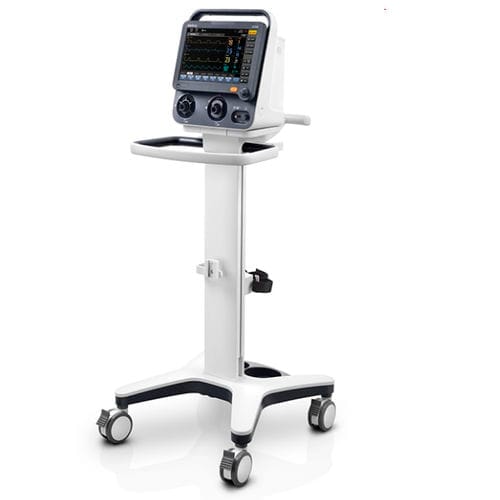
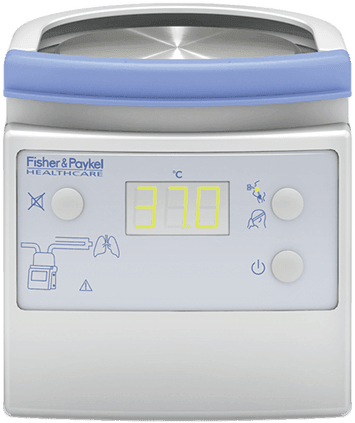
ICU ventilators and heated humidifiers.
What is an ICU ventilator?
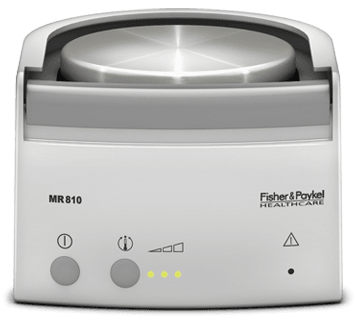
An ICU ventilator assists or replaces a patient's breathing over long periods, in intensive care. It is complemented by a heated humidifier, which warms and humidifies the inspired gases — essential as soon as ventilation lasts more than a few hours.
5 products
Compare specifications — Intensive care
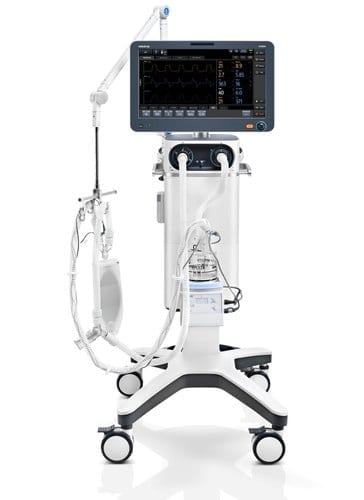
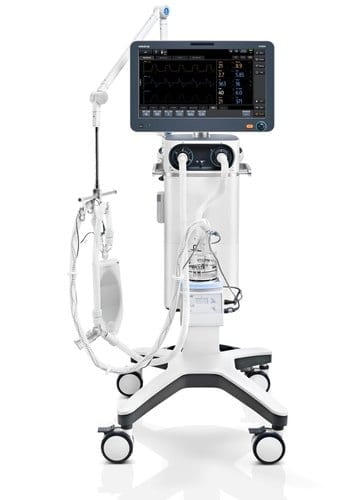
SV600, SV800: values taken from the manufacturers' brochures, downloadable from each product page.
| Specification | SV600 | SV800 |
|---|---|---|
| Tidal volume — adult | Adult: 100 to 4 000 ml | Adult: 100 to 4 000 mL |
| Tidal volume — paediatric | Paediatric: 20 to 300 ml | Paediatric: 20 to 300 mL |
| Tidal volume — neonatal | Neonatal: 2 to 100 ml | Neonatal: 2 to 100 mL |
| Ventilation rate | Adult / paediatric: 1 to 100/min | Adult/Paediatric: 1 to 100/min |
| Oxygen concentration | 21 to 100 vol.% | 21 to 100 % by volume |
| I:E ratio | 1:10 to 4:1 | 1:10 to 4:1 |
| Inspiratory time | 0.10 to 10.00 s | 0.10 to 10.00 s |
| Weight | Approximately 45 kg | Approximately 48 kg |
Where is it used?
An ICU ventilator runs continuously for days, sometimes weeks, in an intensive care unit. It is operated by intensivists and nurses, and the readability of its interface matters as much as its performance: a setting error has immediate consequences. The fleet must be sized to absorb peaks in activity, not calibrated on average occupancy. The facility's oxygen and medical air supply must be checked beforehand: a high-performing ventilator remains unusable if the medical gas network cannot keep up.
What to check before choosing?
- Ventilation modes and built-in decision support tools
- Neonatal module: some ventilators go down to tidal volumes of 2 ml
- Battery autonomy and backup supply in the event of an air supply failure
- Humidification: compatibility between ventilator and humidifier should be checked before purchase